Several BIDMC System IT leaders attended HIMSS this year to help us select the most innovative solutions for our 5 strategic pillars.
Manu Tandon, CIO of Beth Israel Deaconess Medical Center shared his notes with me and with his permission, I’d like to share them with you:
“Population health conversation last year was about maximizing revenue for the organization. Now it's about identifying and managing cohorts of patients using patient generate data as a source. The best thinking we saw aligns very well with ours. A workflow oriented EHR centric model that closes the gap between operations and analytics is the way to go. Separate big data platform based approaches are fading away.
Sensed a very noticeable increase is the use of mobile platforms and mobile apps in marketing literature. Mostly stand alone apps with some integration capability. The EHR vendors in general seem to be behind the curve on this especially for two way interactions. The pure mobile app vendors are struggling building API based integration with a majority of EHR vendors. They are all, however, striving for integration. Again felt our approach was validated here with our crowdsourcing based WebOMR API driven mobile platform strategy. Without payment model reform the commercial adoption would lag.
Our thinking on patient centered care team coordination is ahead of the market. Secure texting as a standalone solution has limited potential. The real deal is in an EHR centric approach that is personalized, integrated and keeps documentation in natural alignment with communication.
The conversation around inclusion of patient generated data in the care continuum took a lot of bandwidth at HIMSS. Some are doing this already with some level of integration but all seem to be striving toward this goal. Payment reform to compensate for this is the catalyst they are all waiting for.
The baton for interoperability - the buzz word of past HIMSS - has clearly passed from the federal domain to the private sector. The near future may belong more to targeted interoperability vs a broad based all data everywhere all the time type of solution.
Overall, felt like our approach to population health, care team collaboration, mobile applications, internal improvements and targeted interoperability was strongly validated. Strong governance and a heads down workman like approach is our best chance to progress on this journey. "
Wednesday, March 9, 2016


Thursday, March 3, 2016
Unity Farm Journal - First Week of March 2016
I’ve been traveling this week, so Kathy has been carrying the full weight of running Unity Farm. Here are her notes from the past few days:

“The mother coyote is raising another litter of kits and she’s clearly anxious to feed herself and them. She’s leaving the den twice a day (during daylight) in an attempt to grab a chicken, duck or guinea (the geese are too big). As usual, all 60 guineas gather into a flash mob as soon as she arrives and chase her back to the den. There is definitely strength in guinea numbers. We really do not want to harm her, but we also do not want to lose any poultry. A neighbor suggests a paint gun - frightening but not damaging - as a coyote deterrent.
The salad greens are growing nicely in the hoop house beds and the germination area. The peas have sprouted and our late winter crop is enjoying the warmth of the approaching Spring.
The geese are laying every other day. Both Gabrielle and Hercules are using the nest box near the front door woodpile.

We’re creating a new summer pig paddock in the barnyard which means relocating the wood splitting area. There will be cool shade, plenty of mud and breezes coming off the drumlin to keep the pigs comfortable in summer. Since they do not sweat, they cannot stay in the sunny winter paddock
All this activity is its own fitness program. Who needs a spin class when you’re running a farm!”
This weekend I’ll be moving wood to clear land for the new paddock, rebuilding one of garden ponds that leaked over the winter, and harvesting vegetables that have matured in my absence. The post HIMSS week is relatively sedate but next weekend, I’m flying to Austin for a South by Southwest keynote, then leaving for Hong Kong for a few days of teaching/mentoring/planning in nearby Shenzhen with side trips to Shanghai and Suzhou. From China, I’ll fly back through Los Angeles to keynote an American Dental Association conference, then return to Boston. April brings a 2 day trip to the UK to join Bob Wachter and colleagues for an IT review of the National Health Service. May includes a weekend commencement speech in Texas. Thankfully there will no travel between May and an October 28 New Zealand keynote. Kathy’s days alone on the farm will be very minimal this Summer, which is great because our daughter’s wedding is coming up in late May.
It’s good to be home.
Wednesday, March 2, 2016
Dispatch from HIMSS
Every year I walk the HIMSS floor and speak at HIMSS events with the hope that I can distill the conference sensory overload into a few key themes.
In the recent past, big data, interoperability, personalized medicine, population health, and wearables were buzzwords in every booth
This year, the buzzwords were replaced by one overarching concept - providers and vendors must innovate or die.
In the next 24 months we’ll see an accelerating evolution of fee for service into alternative payment models fueled by MACRA and MIPS. We will no longer be driven by compliance imperatives (Meaningful Use, HIPAA, Affordable Care Act, and ICD10), but instead will need to improve outcomes in order to survive financially. No one is completely sure how to do that, but there are enablers.
Providers will be responsible for the care that their patients receive throughout the community - inpatient, outpatient, urgent care, post acute care and home care all contribute to total medical expense and wellness. Some of the care may be delivered by people and organizations outside the of the control of primary care givers. The only way they can succeed is by aggregating data from payers, providers, and patients/families in an attempt to provide “care traffic control”
Doing this requires tools for team-based care and communications, functions that may not be provided by the core EHR vendor. Instead, an ecosystem of apps, services, and connectivity will surround the EHR to enhance usability and workflow. A few idea/products to watch
Surescripts National Record Locator Service - a master patient index which provides pointers to the medical records of patients at every site of care.
Commonwell - a collaboration of vendors also providing master patient index services.
DirectTrust - creates a scalable way for trading partners to establish trust relationships without requiring bilateral participation agreements with every participant. i.e. without DirectTrust 20 trading partners would require 20x20 (400) agreements. DirectTrust also supports a national provider directory
FHIR-based application program interfaces (APIs) - with APIs, provider to provider and patient-provider data exchanges are simpler to engineer and support. Just about every EHR vendor has agreed to support FHIR APIs this year.
Cloud-hosted services - the era of locally hosted licensed software is ending and being replaced by agile services that can be turned on and off with minimal capital investment. As healthcare gets bigger through merger and acquisitions it will become increasingly important for affiliated organization to leverage a common pool of cloud hosted services.
In the View from the Top keynote I did with Jonathan Bush (the yin to my yang) we left the audience with a call to action.
It is possible today to connect the healthcare ecosystem using the enablers listed above. We do not need to wait for the perfect standard or the next round of prescriptive regulations.
It’s happening now and companies that are early movers in telehealth, connectivity, and care management will out compete the laggards
It’s time to replace compliance (fear of failure/sanction) with determination (joy of success) to make healthcare better. Although some of the innovations sound like they could increase risk (cloud/mobile/apps), in fact they are likely to reduce risk by leveraging the experience of a larger number of people outside any given institution.
I left HIMSS this year with great optimism. Vendors, technologies, and incentives are aligned for positive change. 2016 will be a great year.
Thursday, February 25, 2016
Unity Farm Journal - Fourth Week of February 2016
You may have heard the term “lipstick on a pig”, which generally refers to dressing up a flawed product. You may have also heard the term “lipstick on your collar”, which generally refers to evidence of an affair. However, you may not have heard of “pig lipstick on your collar”. Here’s the story:
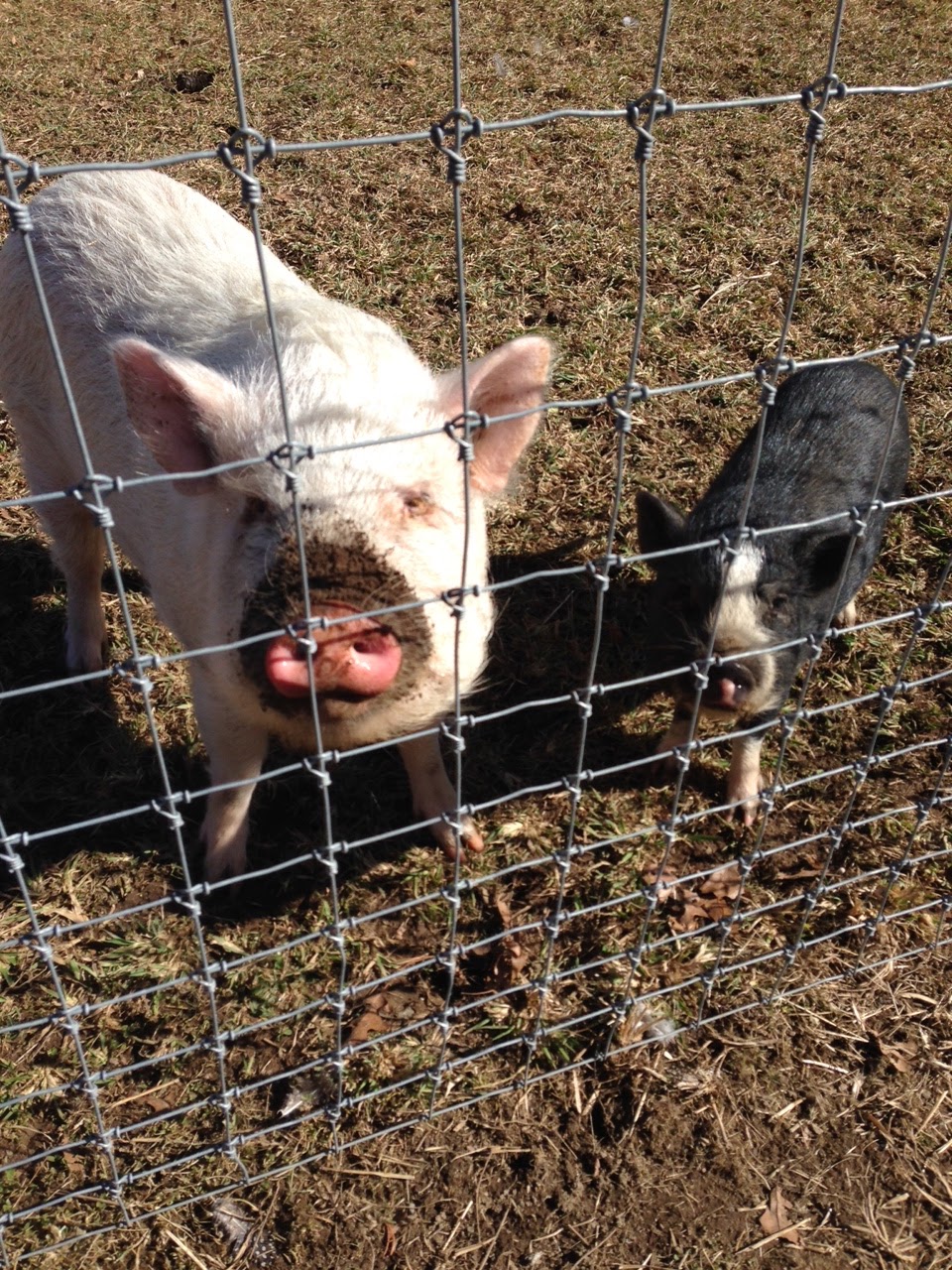
After I feed the pigs every night,I give them stomach rubs and tuck them into their beds of straw. Hazel Marie, who weighs 120 pounds, generally spends the day rooting for grubs, worms, and tender vegetable shoots. By nightfall, her snout is covered with mud as pictured below. Pigs are very intelligent and communicative creatures, and their nose disks are their major sensory organ - they push, smell, and explore with their nose disks. After a stomach rub, she will often nuzzle with me, by rubbing her wet nose disk across my face. I did not realize that I came to dinner last weekend with “pig lipstick on my collar” - my nose was covered with mud from pig affection. The cat (or pig) was out of the bag. Kathy forgave me.


February is a busy time at Unity Farm because we are four season farmers. We harvest vegetables every day of the year, even when it’s -34F outside. We do this by using our hoop house, our row covers, our indoor and outdoor germination stations, heat mats, and grow lights. Now that the worst of winter has passed, I planted 15 raised beds with germinated vegetables. Here’s our 2016 Winter/Spring succession planting plan for the hoop house
Left side
Bed 1 - Rex Greenhouse lettuce -> Bell peppers
Bed 2 - Vit Mache -> Roma tomatoes
Bed 3 - Buttercrunch Bibb lettuce -> Heirloom Beefsteak tomatoes
Bed 4 - Nancy Boston lettuce ->Plum tomatoes
Bed 5 - Sugar and Snap peas ->
Bed 6 - Bloomsdale Spinach -> Jacob’s Cattle beans
Bed 7 - Haruke Turnips ->
Right side
Bed 1 - Chiogga Beets ->
Bed 2 - 8 different types of carrots
Bed 3 - Red Cross lettuce -> Jalapeño peppers
Bed 4 - Meadowlark Kale ->
Bed 5 - Bloomsdale Spinach -> Jacob’s Cattle beans
Bed 6 - Winter Density Romaine -> Little Finger Eggplant
Bed 7 - 8 different types of carrots
Bed 8 - Rouge D’ Hiver Romaine -> H19 Cucumber
We’ll also have a Fall crop in every bed including Argulua, Ottos, Endive, Lettuces, Mache, Parsley, Radicchio (a Chicory), Scallions, Spinach, Upland Cress
Outside of the hoop house, we’ll plant squash and pumpkins in the compost piles.
It’s the middle of February and all our beds are filled with growing plants. The miracle of hoop houses/high tunnels and the greenhouse effect.
I spent last weekend moving tons of fallen branches from winter storms. The Terex front loader is amazing. Here’s how I moved an entire fallen tree in one load to the Shiitake processing area.


The winter storms of February did collapse one of our barn windows - it literally imploded and blew into the barn when a 40 mph gust hit the barn. This week, we hired a carpenter to retrofit every barn window with wood strips to reinforce them against the wind. We should be resilient to any storm that nature can bring.
This weekend, I’m flying to HIMSS for a few keynotes and many meetings. Kathy will be doing barn chores for 3 days as well as tending the new winter plantings - over 1000 new plants. I try to be everywhere for everyone, but having a doppelganger who has been with you for 35 years makes Unity Farm possible.
After I feed the pigs every night,I give them stomach rubs and tuck them into their beds of straw. Hazel Marie, who weighs 120 pounds, generally spends the day rooting for grubs, worms, and tender vegetable shoots. By nightfall, her snout is covered with mud as pictured below. Pigs are very intelligent and communicative creatures, and their nose disks are their major sensory organ - they push, smell, and explore with their nose disks. After a stomach rub, she will often nuzzle with me, by rubbing her wet nose disk across my face. I did not realize that I came to dinner last weekend with “pig lipstick on my collar” - my nose was covered with mud from pig affection. The cat (or pig) was out of the bag. Kathy forgave me.

February is a busy time at Unity Farm because we are four season farmers. We harvest vegetables every day of the year, even when it’s -34F outside. We do this by using our hoop house, our row covers, our indoor and outdoor germination stations, heat mats, and grow lights. Now that the worst of winter has passed, I planted 15 raised beds with germinated vegetables. Here’s our 2016 Winter/Spring succession planting plan for the hoop house
Left side
Bed 1 - Rex Greenhouse lettuce -> Bell peppers
Bed 2 - Vit Mache -> Roma tomatoes
Bed 3 - Buttercrunch Bibb lettuce -> Heirloom Beefsteak tomatoes
Bed 4 - Nancy Boston lettuce ->Plum tomatoes
Bed 5 - Sugar and Snap peas ->
Bed 6 - Bloomsdale Spinach -> Jacob’s Cattle beans
Bed 7 - Haruke Turnips ->
Right side
Bed 1 - Chiogga Beets ->
Bed 2 - 8 different types of carrots
Bed 3 - Red Cross lettuce -> Jalapeño peppers
Bed 4 - Meadowlark Kale ->
Bed 5 - Bloomsdale Spinach -> Jacob’s Cattle beans
Bed 6 - Winter Density Romaine -> Little Finger Eggplant
Bed 7 - 8 different types of carrots
Bed 8 - Rouge D’ Hiver Romaine -> H19 Cucumber
We’ll also have a Fall crop in every bed including Argulua, Ottos, Endive, Lettuces, Mache, Parsley, Radicchio (a Chicory), Scallions, Spinach, Upland Cress
Outside of the hoop house, we’ll plant squash and pumpkins in the compost piles.
It’s the middle of February and all our beds are filled with growing plants. The miracle of hoop houses/high tunnels and the greenhouse effect.
I spent last weekend moving tons of fallen branches from winter storms. The Terex front loader is amazing. Here’s how I moved an entire fallen tree in one load to the Shiitake processing area.


The winter storms of February did collapse one of our barn windows - it literally imploded and blew into the barn when a 40 mph gust hit the barn. This week, we hired a carpenter to retrofit every barn window with wood strips to reinforce them against the wind. We should be resilient to any storm that nature can bring.
This weekend, I’m flying to HIMSS for a few keynotes and many meetings. Kathy will be doing barn chores for 3 days as well as tending the new winter plantings - over 1000 new plants. I try to be everywhere for everyone, but having a doppelganger who has been with you for 35 years makes Unity Farm possible.
Wednesday, February 24, 2016
The Pillars of the BIDMC IT Strategic Plan
Communicating the IT strategic plan is one of the primary responsibilities of a CIO. Most importantly, the IT strategic plan should be seen as an enterprise wide activity and not just an IT centric exercise. IT should be an enabler for the strategy of the business and every IT tactic should tie back to a high priority of the business.
In 2016, the BIDMC IT strategic plan has five pillars that align with quality, safety and efficiency imperatives (instead of Meaningful Use, ICD10, and the Affordable Care Act as was the case 2013-2015). The pillars are:
1. Inpatient documentation which integrates novel communication methods such as groupware and secure texting
2. Crowdsourced mobile apps as an enabler for patient generated healthcare data
3. Security
4. Care Management Medical Records (our term for population health integrated into the EHR)
5. A move to the cloud including interoperability of data, documents, and images
Here’s a bit more detail about why these are driving our work in 2016
Documentation - although many organizations have been at HIMSS Level 7 and had paperless inpatient medical wards, BIDMC has purposely waited for the technology to evolve so that we have better usability and ergonomics. In 2016, we’ll be able to use the internet of things, natural language processing, cloud-based voice recognition, social networking ideas, and mobile to create an entirely different documentation experience. We’re partnering with an equipment vendor to provide our nurses with a single device that wirelessly transmits all vital signs and observations into the EHR as structured flowsheet data. We’re engineered a novel approach to searching all medical record content for much easier navigation of previously written content. Cloud based voice recognition will enable clinician voice input to the medical record from any device, at any location, for any document. Groupware and secure texting will enable team communication with better workflow than email and reading charts. Everything is optimized for mobile. Sometimes it pays to be a laggard when the clinician experience depends upon waiting for the convergence of technology, regulation, and demand.
Mobile apps - today, 80% of all BIDMC publicly available content/portals is accessed by mobile devices. The desktop is dead. If we want to engage patients and families we must gather subjective (how do you feel), objective (what is your blood pressure), and care plan progress on mobile devices. We’ve already launched BIDMC@Home to gather the objective data. In 2016 we’ll be adding new functionality to share even more data between doctor and patient.
Security - I’ve written about the Cold War that is security and the fact that security is a process not a project, that will never be complete. We must make security the foundation of every application we launch and every infrastructure we procure.
Care Management Medical Records - What is population health? If you ask 10 clinicians, you’ll get 12 answers. Our view is that care management requires identification of a cohort based on about 50 data elements (problems, meds, allergies, labs, demographics) then inserting that cohort into a queue with a plan/to do list for the entire care team (doctors, nurses, social workers, pharmacists, physical therapists etc) to process. We’ve created a generalizable framework for care management and in 2016 we’ll roll it out broadly.
Cloud hosted services - As I wrote two weeks ago, agility requires the use of cloud hosted services. We’re partnering with many vendors - Amazon, Google, Dell, Meditech, and AthenaHealth to move core functionality to the cloud in a way that builds greater data liquidity/information sharing while also protecting privacy.
It’s hard to create an elevator speech for IT but if I told you that we’re putting usability and the clinician/patient needs first, instead of overly prescriptive regulations, and using social networking, mobile analytics, and cloud to create automation that meets the goals of the business, I hope you would stand and cheer.
The five pillars of BIDMC IT in 2016 are our best hope to bring joy back to the practice of medicine.
Thursday, February 18, 2016
Unity Farm Journal - Third Week of February 2016
A few years ago, I wrote about keeping warm in New England when alpine climbing in -40F weather.
Over the weekend at Unity Farm, it was -35F with wind chill and -15F without. While using my ice ax to break up manure in the barn (really), I wore the same gear I use for the White Mountains.

On Saturday night we had to prepare every animal area for what turned out to be the lowest recorded temperatures ever in the Boston area, caused by the polar vortex.
Llama/alpacas - we cleaned their barn stalls right before nightfall and added extra hay on top of their rubber mat floors so that each animal would have a dry, insulated, wind protected shelter. I fed them chopped alfalfa with molasses to given them extra calories and added flavoring to the water in their heated buckets to encourage them to stay hydrated.
Dogs - we put a 1500 watt space heater in the barn in an effort to keep the temperature for the dogs near zero. We created insulated beds for them by wrapping hay in tarps. We gave them extra food before bed.
Chickens/Guinea fowl - we closed the coop at 3:00pm to retain the warmth of the day and ensured the three panel heaters on the roof over their roosts were functioning well. We made them a pot of warm oatmeal and added extra pine shavings to the floor, so everyone would be warm and dry
Geese/ducks - we added extra straw their waterbird house and made them warm oatmeal. The ducks love their warm heated nesting area, but the geese seem to prefer to stay in the outside pen no matter how cold it gets.
Pigs - our real concern was the pigs because they do not like cold. They have panel heaters above their straw beds, but with low wattage heaters, blankets, and straw they are still cold when the temperatures go below zero. We added a 1500 watt space heater to their pig barn, gave them extra food (grain/bananas), and wrapped them in their quilts.
On Sunday morning, I waited until dawn to check on everyone, so they would not be disturbed from their shelters. Everyone made it through the night without a problem.
As I went into the farm refrigerator (35F) to get vegetables for the pigs, I took the opportunity to warm up, because the inside of the refrigerator was 50 degrees warmer than the barnyard!
During the winter we keep water flowing in our duck pond on the farm for the deer, birds, and other local wildlife. To keep the pumps and piping flowing in the negative temps, I did my best to break up ice, use snow as an insulator, and cleaned all the filters. We are the only liquid water for miles around.
In the picture below, you’ll see some of our geese. Hercules (the large french tufted goose in the photo below) began to collect straw from around the barnyard this week. I got the sense that Hercules wanted to nest. Our geese were raised from 3 day old (unsexed) hatchlings so their gender is still unknown to us. I built an 18x36 inch box, pictured below.


A few hours later, I returned to find the goose egg pictured below (yes, it is enormous). We now know that Hercules is female. So far, no eggs from Xena, Gabrielle, or Iolaus. Our guess is that Iolaus is male and all the others are female. When the weather is warmer, we’re happy to let the geese hatch any fertile eggs. At the moment, eggs left outside just explode in the cold.

We had planned to transplant our lettuce sprouts last weekend, but with negative temperatures, even hardy lettuce would struggle. Next weekend, we’ll plant all our transplants and early spring crops in the hoop house. As with everything else at Unity Farm, we’re learning every day. It’s unclear if late February is the right time to plant lettuce in the hoop house. In a few weeks, we’ll know if we were right!
Wednesday, February 17, 2016
Enabling Nationwide Interoperability
Today’s post is co-written by Micky Tripathi, CEO of the Massachusetts eHealth Collaborative, and me.
It’s been over 10 years since ONC head David Brailer and HHS Secretary Tommy Thompson published the “The Decade of Health Information Technology”, one of the goals of which was to create a “a new network to link health records nationwide.” Since the beginning, government planners have advanced the notion of a national-level network, at first suggesting a single “national health information network” architecture, which was later modified to be a “nationwide health information network” built on a foundation of federally-subsidized regional health information organizations (RHIOs) working together across the country. More recently, the ONC Interoperability Roadmap, recognizing that the building blocks of universal interoperability could not be so neatly erected, leans on the idea of “coordinated governance” of networks.
While these frameworks have paid homage to the concept of nationwide network as a “network of networks”, we have yet to crisply define the stitching needed to form this nationwide network quilt. This issue hasn’t been so pressing up until now because there were relatively few networks – the “last mile” problem was the bigger concern. Network formation is evolving rapidly, however, which has made more pressing the question of what it means to connect networks in a uniform way.
We believe that there are five key interoperability transactions that need to be operationalized across networks in order to achieve the goal of nationwide interoperability. Those are:
1. Patient matching/identification
2. Provider directory supported by a FHIR query/response transaction
3. Constrained CCDA payload with little to no optionality
4. Data-level FHIR API for MU common data elements and a document-level FHIR API for a CCDA supported by a standard schema and controlled vocabularies
5. OAuth/OpenID Trust fabric supported by appropriate HIPAA/state/local policies for consent
There are obviously many other interoperability functions that have value in the market, but we believe that those are best left to individual networks to provide within their networks as their customers and stakeholders see fit and are willing to pay for and enable. This is exactly how other network-based industries have developed. Wireless connections work seamlessly across networks even though within their networks they don’t all use the same standards or offer the same functions (e.g., Verizon users can do more with each other than they can with AT&T users, for example, which is also true for iphone users).
We obviously made some decisions about what to relegate to within network. For example, what about a record locator service? We do appreciate the value that record location can provide, but given the variation in network architectures that exists today and the policy complexity involved, we see this as a capability that is best left for the future. We also caution against letting the perfect be the enemy of the good. It’s important that we begin with achievable, practical steps and grow from there.
How would this be accomplished? Network development is now at the point where the private sector – a small group of existing networks such as CommonWell, Epic CareEverywhere, Surescripts, DirectTrust, the eHealth Exchange – should assemble to roll up their sleeves and agree on practical, federated solutions to these five issues. And if the experiences of other network industries is any guide, once a critical mass of networks launches such functions according to open industry standards, the rest of the market will soon follow.
In our various speaking events at HIMSS this year, you’ll hear a call to action from Micky and me to move this agenda forward.
Subscribe to:
Posts (Atom)


